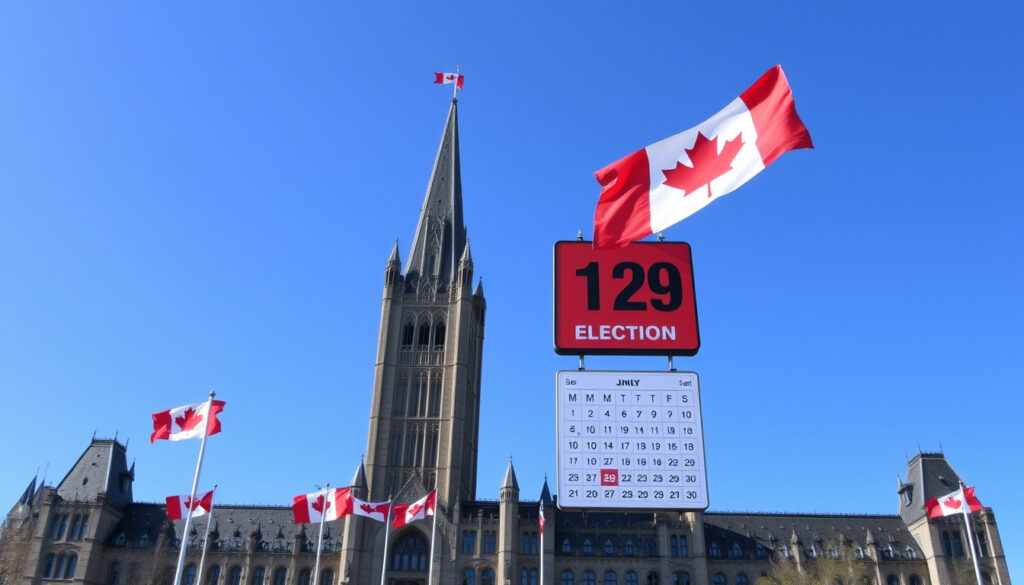
When Is the Next Canadian Federal Election? Date & Schedule
Canada’s election calendar works differently than many expect. While federal law sets a fixed date for the next vote, the 45th Parliament proved that rule can bend — Prime Minister Mark Carney called a snap election on April 28, 2025, months ahead of the legally mandated deadline. Understanding when the next federal election is actually due requires a quick tour through the Canada Elections Act, the role of the Governor General, and why those who study Canadian politics keep one eye on 2029.
Last Federal Election: April 28, 2025 · Next Parliament: 46th Canadian Parliament · Election Frequency: Maximum every 5 years per Canada Elections Act · By-elections Scheduled: April 13, 2026 · Key Dates Source: Elections Canada
Quick snapshot
- The 45th Parliament was elected on April 28, 2025 (2025 Canadian Federal Election – Wikipedia)
- Governor General Mary Simon issued writs on March 23, 2025 (2025 Canadian Federal Election – Wikipedia)
- Fixed-date rules allow elections every 4 years on the third Monday in October (Electoral Cycle – Elections Canada)
- The exact date of the 46th general election (though it must fall by October 2029)
- Whether any future Prime Minister will call a snap election before the fixed date
- How the Liberal minority government’s stability affects potential early dissolution scenarios
- Fixed federal election date set for October 15, 2029 (Fixed Election Dates – Wikipedia)
- Constitution Act 1867 prohibits Parliament terms exceeding five years (Section 4 – Justice Canada)
- By-elections scheduled for April 13, 2026, in specified ridings (Fixed Election Dates – Wikipedia)
- 46th Parliament convenes following the 2025 election; its maximum term runs to 2030
- By-elections on April 13, 2026, will fill specific vacant ridings
- Next fixed federal election by October 15, 2029, unless a snap election is triggered
The table below summarizes key Canadian federal election dates and statutory requirements derived from official sources.
| Label | Value |
|---|---|
| 45th Election Date | April 28, 2025 |
| 46th Election Status | Scheduled per Canada Elections Act |
| By-elections | April 13, 2026 |
| Key Dates Start | March 23 |
| Election Period (Min) | 37 days |
| Election Period (Max) | 51 days |
| Fixed Date Rule | Third Monday October, fourth year after prior |
| Next Fixed Election | October 15, 2029 |
When was the last federal election in Canada
Canadians went to the polls on April 28, 2025, for the 45th Canadian federal election. Prime Minister Mark Carney advised Governor General Mary Simon to dissolve Parliament, and writs of election were formally issued on March 23, 2025 — a classic snap election that came months before the original fixed-date deadline of October 20, 2025. The return of writs was scheduled for May 19, 2025.
The 2025 vote demonstrated that Canada’s fixed-date framework, while influential, carries no constitutional bar against early elections. As Justice Canada notes, the Canada Elections Act’s Section 56.1 does not create a convention preventing early dissolution. The Governor General acts on the Prime Minister’s advice, meaning Parliament’s lifespan ultimately depends on political judgment — not a calendar alone.
Advance polls for the 2025 election ran April 13–16 (open) and April 18–21 (assigned), with open voting available to all eligible Canadians regardless of their home riding at designated campuses like Concordia University. The election produced a Liberal minority government, with results formally certified by Elections Canada on May 19, 2025.
2025 election details
The 45th Parliament marked a notable shift from the previous government’s trajectory. Following Prime Minister Justin Trudeau’s resignation and the subsequent Liberal leadership change, the party under Carney called an early election seeking a fresh mandate. The snap timing surprised many observers but followed established constitutional practice.
A 2024 bill to shift the 2025 fixed date to October 27 died in Parliament after prorogation — illustrating how political timing and procedural delays can override even planned date changes.
How often does Canada have federal elections
Canada’s federal election schedule rests on two pillars: the Canada Elections Act’s fixed-date provisions and the constitutional hard limit. The Act, amended with royal assent on May 3, 2007, established that federal elections should occur on the third Monday in October in the fourth calendar year after the previous election’s polling day. That sets an expectation of roughly every four years — but “expectation” is the operative word.
The Elections Canada electoral cycle guidance confirms that federal election periods must be at least 37 days and no more than 51 days, with election day falling on a Monday. This minimum period was shortened to 36 days in December 1996 amendments, creating the modern 37-day floor once pre-poll timing is factored in.
Constitutionally, no Parliament can exceed five years. Section 50 of the Constitution Act 1867 and Section 4 of the Charter both cap terms at five years, meaning an election must occur within that window regardless of what the fixed-date schedule says. Fixed dates are enacted by simple majority and can be changed by the same mechanism — Parliament retains full control over its own calendar.
Fixed-date rules
The fixed-date system, which started with the October 19, 2009 election, was designed to bring predictability to Canadian politics. By setting dates four years apart, parties and voters can plan around known election windows. However, the 2025 snap election exposed the system’s flexibility: fixed dates can be overridden whenever the Prime Minister advises the Governor General to dissolve Parliament, whether due to a lost confidence vote, strategic timing, or political calculation.
Maximum intervals
Beyond the four-year fixed window, the five-year constitutional ceiling is the true backstop. If no election occurred by April 28, 2030 (five years after the 2025 polling day), the Governor General would be constitutionally obligated to issue writs regardless of any government’s preference. In practice, Canadian history shows no Parliament has ever reached that ceiling — but the mechanism exists as a democratic failsafe.
When can a federal election be called in Canada
A federal election in Canada is formally triggered when the Governor General issues writs of election, acting on advice from the Prime Minister. This advice can come at any time — there is no fixed trigger requiring a specific political event. The Governor General’s role is largely ceremonial in this context; once the Prime Minister advises dissolution, the writs follow.
The Elections Canada calendar of activities specifies that election day must fall at least 36 days after writ issuance, with the total campaign period spanning 37 to 51 days depending on how the dates align with weekends and statutory holidays. Once writs are issued, the election machinery — candidate nominations, advance polls, election officials — activates across all 343 ridings.
Fixed dates
The fixed-date framework, codified in Section 56.1 of the Canada Elections Act, aims to establish regular, predictable elections. Under this rule, the next federal election after 2025 would normally be scheduled for October 15, 2029 — the third Monday in October, four years after the 2025 polling day. The pre-election period for fixed-date elections begins June 30 before election day, with spending limits applying to registered parties during that window.
Snap election triggers
Despite the fixed-date framework, the Governor General can issue writs at any time on Prime Ministerial advice. Common triggers include a lost confidence vote in the House of Commons, a Prime Minister’s strategic decision to seek a new mandate, or the resignation or death of a sitting Prime Minister. The 2025 election demonstrated this: Carney advised early dissolution despite the October fixed date, and the Governor General obliged within days. No legal threshold — beyond the PM’s advice — must be crossed for a snap election to proceed.
Fixed dates benefit opposition parties and voters who want predictability, but they can lock in governments facing political headwinds. For sitting Prime Ministers, the ability to call early allows strategic timing — a gamble that can backfire, as Canadian history shows with several snap elections ending in minority governments or premature defeats.
Will there be a federal election in Canada 2026
There will be a federal electoral event in Canada in 2026, but it will be by-elections, not a general election. Prime Minister Carney announced by-elections scheduled for April 13, 2026, in specified ridings. These by-elections fill individual parliamentary seats that have become vacant due to resignations, deaths, or other circumstances — they do not trigger a nationwide general election.
The Government of Canada’s election calendar lists no upcoming federal general election for 2026. The calendar tracks provincial and territorial elections across the country; notably, Quebec’s provincial election is set for October 5, 2026, and Alberta’s for October 18, 2027, but federal general election activity in 2026 is not on the schedule.
By-elections vs general
The distinction matters. A by-election affects one riding at a time, costs significantly less than a general election, and does not reset the national political mandate. A general election, by contrast, elects all 343 Members of Parliament and determines which party forms government. By-elections become politically significant when a government holds a small majority or minority, as each seat lost can threaten the administration’s survival — but the April 2026 by-elections are not expected to trigger a broader political crisis given the current parliamentary arithmetic.
2026 announcements
By-election announcements come from the Prime Minister’s Office, with the Governor General issuing writs for specific ridings. The timing — April 13, 2026 — places by-election polling on a Monday, consistent with the election-day-on-Monday requirement. Advance polls would typically open approximately two weeks before election day. These dates are managed by Elections Canada, which prepares electoral infrastructure in advance based on anticipated vacancy notifications from the House of Commons.
When is the next federal election in Canada
Under the Canada Elections Act’s fixed-date provisions, the next federal general election in Canada is scheduled for October 15, 2029 — the third Monday in October, four years after the 45th Parliament’s polling day. This date represents the legal default: absent an early dissolution, Canadians would vote on or around that date to elect the 46th Parliament.
However, the 2025 precedent makes clear that “scheduled” does not mean “certain.” The Liberal minority government formed in April 2025 holds fewer seats than a majority, meaning the Carney administration could face a confidence vote at any time before 2029. If the government loses confidence, the Governor General would almost certainly dissolve Parliament on the Prime Minister’s advice, triggering an early election regardless of the fixed-date framework.
46th election outlook
The 46th Canadian federal election will elect MPs to the 46th Parliament. Political observers note several factors that could influence timing: the minority government’s need to build coalition support on key legislation, potential economic pressures that could shift public sentiment, and the strategic calculations of both the governing and opposition parties. While October 2029 is the statutory default, Canadian political history suggests planning for a wider window.
Post-2025 schedule
Beyond the 46th Parliament’s eventual election, the electoral calendar includes provincial votes that may interact with federal dynamics. Quebec’s October 5, 2026 provincial election will produce a new Quebec government before any federal vote, potentially affecting federal-provincial relations. Alberta’s October 18, 2027 fixed-date election and British Columbia’s October 21, 2028 date provide additional provincial context within the federal timeline window.
For political watchers, the key signals are confidence vote outcomes, by-election results in 2026, and any formal changes to the Canada Elections Act. A minority government that survives 18 months without a confidence challenge has historically demonstrated greater resilience — but Canadian parliamentary history offers no guarantees.
Timeline
Eighteen years of Canadian election history reveal a system where legal frameworks and political pragmatism constantly intersect. From the 2007 fixed-date amendment to the 2025 snap election, key dates show how statutory schedules and political will share the stage.
The timeline below tracks pivotal moments in Canadian federal election scheduling since the fixed-date system began.
| Date | Event |
|---|---|
| May 3, 2007 | Canada Elections Act fixed-date amendment receives royal assent |
| March 23, 2025 | Parliament dissolved, writs issued for snap election |
| April 28, 2025 | 2025 federal election polling day (45th Parliament) |
| May 19, 2025 | Return of writs for 2025 election |
| April 13, 2026 | By-elections in specified ridings |
| October 5, 2026 | Quebec provincial election |
| October 15, 2029 | Next fixed federal election (currently scheduled) |
What we know — and what we don’t
Certainty and uncertainty coexist in Canada’s election calendar. Confirmed facts provide a reliable skeleton for planning; open questions remind readers that democratic timelines ultimately depend on human decisions, not just legal rules.
Confirmed facts
- The 2025 election took place on April 28, 2025
- The Canada Elections Act allows elections every four years on the third Monday in October
- The 2025 snap election was legal and constitutional despite bypassing the fixed date
- No Parliament can constitutionally exceed five years
- By-elections are scheduled for April 13, 2026
- The next fixed federal election date is October 15, 2029
What’s unclear
- Whether the Liberal minority government will survive to the fixed 2029 date
- What economic or political trigger might prompt an early election call
- How election period lengths might change if future legislation amends the Act
- Whether provincial dynamics in 2026-2028 will influence federal timing
What people are saying
The election or campaign period must be at least 37 days and no more than 51 days, and election day must fall on a Monday.
— Elections Canada (Official Electoral Cycle Guidance)
Under the fixed-date provisions of the Canada Elections Act, federal elections are required to be held on the third Monday in October in the fourth calendar year after the polling day of the previous election.
— 2025 Canadian Federal Election – Wikipedia
Summary
Canada’s federal election calendar blends legal predictability with political flexibility. The Canada Elections Act sets a fixed date of October 15, 2029, for the next general election — but the 45th Parliament’s snap election in April 2025 proved that date can bend when the Prime Minister advises otherwise. For Canadians, the practical takeaway is clear: expect the next federal vote around October 2029, but stay alert to the possibility of an earlier call if minority government dynamics produce a confidence vote before then. The April 2026 by-elections will fill vacant ridings but will not reset that national timeline. Watch confidence votes in the House of Commons, economic indicators, and any formal election timing legislation — those are the real bellwethers for when Canada next goes to the polls nationally.
Related reading: Toronto Pride Parade 2025 · Life Expectancy in Canada Male vs Female
Frequently asked questions
What is the Canada Elections Act election timeline?
The Canada Elections Act, Section 56.1, establishes that federal elections should occur on the third Monday in October in the fourth calendar year after the previous election’s polling day. This creates a default four-year cycle, with October 15, 2029, currently set as the next fixed date. However, the Act does not prevent early elections; the Governor General can issue writs at any time on Prime Ministerial advice.
How are by-elections different from federal elections?
A by-election fills a single vacant seat in Parliament and does not affect the overall government mandate. A federal general election elects all 343 MPs and determines which party forms government. By-elections, like the April 13, 2026 events, run on the same voting day rules (Monday) and similar campaign timelines, but their political stakes are localized rather than national.
Who calls a federal election in Canada?
The Prime Minister advises the Governor General to dissolve Parliament, and the Governor General issues writs of election. This advice can come at any time — there is no fixed trigger. The Governor General’s role is largely ceremonial in this context; once the Prime Minister advises, dissolution follows. This mechanism was used to call the April 28, 2025 snap election despite the October fixed date.
What happens if an election is called early?
If the Prime Minister advises early dissolution, the Governor General issues writs within days, triggering a 37-to-51-day campaign period. Election day falls on a Monday at least 36 days after writ issuance. The 2025 election demonstrated this process: writs issued March 23, polling day April 28, within the statutory minimum period. Early elections are constitutional as long as the Governor General acts on Prime Ministerial advice.
Where to find official election dates?
Elections Canada publishes the official electoral cycle calendar, including fixed-date rules and campaign period requirements. The Government of Canada election calendar tracks upcoming federal, provincial, and territorial elections. Wikipedia maintains historical timelines of Canadian elections as a reference resource.
Is the Prime Minister directly elected?
No. Canadians elect MPs to the House of Commons; the Prime Minister is the leader of the party that commands a majority (or leads a coalition with enough seats to survive confidence votes). Canadians do not cast direct ballots for Prime Minister. When a Prime Minister resigns or loses their seat, as with Justin Trudeau in 2025, the party selects a new leader — but a general election is required to translate that leadership change into a formal parliamentary mandate.
What are fixed election dates in Canada?
Fixed election dates, established by the 2007 Canada Elections Act amendment, aim to schedule federal elections on the third Monday in October every four years. The first fixed-date election was October 19, 2009. The system was designed to bring predictability, but it carries no constitutional bar against early elections — the 2025 snap election bypassed the October 20 fixed date on Prime Ministerial advice. Fixed dates can be changed by a simple parliamentary majority vote.
More related posts
 Garage Door Repair Costs: €100-€600 Guide for France
 Sophie Rain OnlyFans: Cost, Earnings, and Bop House
 Cardi B Net Worth 2026: $80-100M Estimates & Comparisons
 Ghislaine Maxwell: Conviction, Prison Conditions, and 2026 Inquiry
 Shane Bieber Blue Jays Trade: Who Won? Contract & Age
 Carly Rae Jepsen: Baby, Relationship, Net Worth, and More
 Addison Barger: Age, Salary, Family Wealth, and the Couch Story
 How to Calibrate a 3D Printer: Step-by-Step Guide
