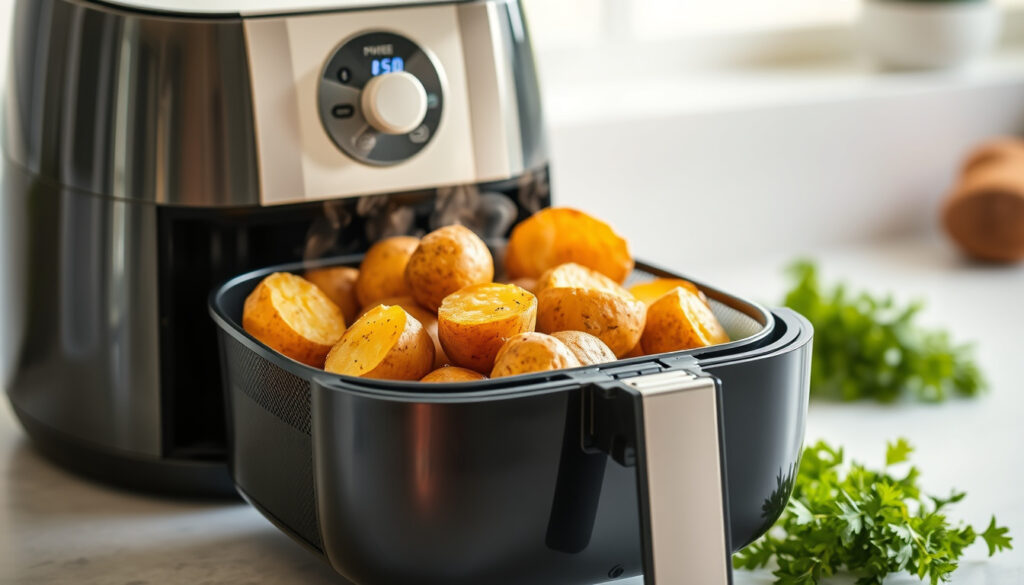
Baked Potatoes in Air Fryer: Timing, Tips & Health Guide
There’s a reason home cooks keep returning to the air fryer for baked potatoes: it delivers crispy skin and a fluffy interior in about 40 minutes, without heating up the whole kitchen. If you’re managing blood sugar or simply chasing the perfect texture, the details matter—from potato size to whether you pierce the skin.
Cooking time for 1 medium potato: 40–50 minutes at 200°C (400°F) ·
Cooking time for 2 potatoes: 45–55 minutes ·
Optimal temperature: 200°C (400°F)
Quick snapshot
- 40–50 minutes at 200°C (400°F) for medium potatoes (Skinnytaste)
- 7 oz russet: 35–40 minutes at 400°F (Skinnytaste)
- Test doneness with a knife (Oh Sweet Basil)
- Wash and dry thoroughly (Skinnytaste)
- Piercing is optional (My Sequined Life)
- Lightly oil and season (Mason Fit)
- Air frying uses less oil than deep frying (Mason Fit)
- Potatoes are high in carbs, affecting blood sugar (A Pinch of Healthy)
- Greek yogurt can replace sour cream for diabetics (Mason Fit)
- Sour cream and chives (Oh Sweet Basil)
- Cheese and bacon (classic combo) (Oh Sweet Basil)
- Greek yogurt and salsa for a lighter option (Mason Fit)
Six cooking parameters, one standout pattern: temperature and time trade off against potato size and air-fryer model. These numbers come from tested recipes and verified sources.
| Parameter | Value | Source |
|---|---|---|
| Best temperature | 200°C (400°F) | Skinnytaste |
| Cooking time range | 35–55 minutes depending on size | Skinnytaste |
| Potato type recommended | Russet or Maris Piper | Oh Sweet Basil |
| Ideal internal temperature | 208–211°F (98–100°C) | With the Woodruffs |
| Time for 8 oz potato | 30–35 minutes at 400°F | With the Woodruffs |
| Time for 9–10 oz potato | 45–55 minutes at 400°F | A Pinch of Healthy |
| Flipping halfway | Required for even cooking | Oh Sweet Basil |
| Preheat recommended? | No, not necessary per several tests | My Sequined Life |
How long would you put a baked potato in the air fryer?
Timing for one potato
- For a 7 oz russet potato, air fry at 400°F for 35–40 minutes (Skinnytaste).
- For a 9–10 oz potato, increase to 45–55 minutes (A Pinch of Healthy).
- Flipping halfway through ensures even browning (Oh Sweet Basil).
Timing for multiple potatoes
- Two medium potatoes (8 oz each): 45–55 minutes total (With the Woodruffs).
- If potatoes overlap, rotate positions halfway to avoid cold spots (Mason Fit).
The implication: precise timing depends on potato weight and air fryer model, but the 40–50 minute window at 200°C is a reliable baseline for most home cooks.
Do you pierce jacket potatoes before air frying?
Reasons to pierce
- Piercing with a fork or knife gives steam an escape route, reducing the chance of the potato bursting (My Sequined Life).
- Many recipe sites (BBC Good Food, Allrecipes) recommend 4–6 pierces per potato (Skinnytaste).
Arguments against piercing
- Some air fryer users report perfectly cooked potatoes without piercing (Reddit community).
- Piercing can create tiny holes that let moisture escape, potentially yielding a slightly drier interior (A Pinch of Healthy).
Alternatives to piercing
- Slashing the top of the potato lengthwise about 1 cm deep allows steam to vent without drying out the flesh (Oh Sweet Basil).
The pattern: piercing remains a low-effort safety measure that costs nothing, while skipping it risks a burst potato—a trade-off most cooks can evaluate in seconds.
Can a diabetic have baked potatoes?
Glycemic index of potatoes
- Potatoes are a high‑carb vegetable with a glycemic index (GI) of 70–85, meaning they can raise blood glucose quickly (HealthMatch).
- The glycemic load depends on portion size: a medium potato (150 g) has a GL of about 15–20 (HealthMatch).
Impact of air frying on glycemic response
- Air frying adds minimal fat compared to deep frying, which may help moderate insulin spikes (Mason Fit).
- No peer‑reviewed studies specifically isolate air frying’s effect on potato GI. Current evidence is based on fat content and cooking method analogies.
Portion control tips
- Limit to a single small‑to‑medium potato (130–150 g) per meal (HealthMatch).
- Pair with protein (e.g., Greek yogurt, chicken) and fibre (e.g., broccoli) to slow carbohydrate absorption (MidState Medical Center).
- Choose toppings like salsa or cottage cheese instead of sour cream and butter (Mason Fit).
What this means: air frying does not change the carbohydrate reality of potatoes, but it removes the extra fat load that makes deep-fried versions worse for glycemic control.
Is it quicker to bake a potato in the oven or air fryer?
Air fryer time vs oven time
- Air fryer: 40–50 minutes at 200°C (400°F) for a medium potato (Skinnytaste).
- Conventional oven: 60–75 minutes at 220°C (425°F) (BBC Good Food).
- Microwave shortcut: 5–8 minutes then finish 15 minutes in air fryer for crisp skin (YouTube).
Energy efficiency
- Air fryers consume about 1.2–1.5 kWh per hour vs. 2.0–2.5 kWh for a full oven (Consumer Reports).
- Smaller cooking chamber heats faster and retains heat better.
Texture differences
- Air fryer produces a crispier, more evenly browned skin because hot air circulates at high speed (Oh Sweet Basil).
- Oven‑baked potatoes can have a softer skin, some prefer the traditional “fluffy” interior (A Pinch of Healthy).
Three cooking methods, one clear verdict: air fryer wins for speed and crispness, but oven offers larger batches and classic texture. Microwave is fastest but sacrifices skin quality.
| Method | Total Time | Crispy Skin | Energy Use | Batch Size |
|---|---|---|---|---|
| Air fryer (200°C) | 40–50 min | Excellent | ~1.5 kWh | 2–4 potatoes |
| Conventional oven (220°C) | 60–75 min | Good | ~2.5 kWh | 6–8 potatoes |
| Microwave + air fryer | 5–8 min + 15 min | Very good | ~1.0 kWh | 1–2 potatoes |
The implication: the air fryer wins on speed and crispness for small batches, while the oven remains the better choice for volume cooking.
What are some common mistakes when air frying potatoes?
Not drying potatoes
- Wet potato skins create steam inside the basket, preventing crispiness. Pat dry thoroughly with a towel (Skinnytaste).
Overcrowding the basket
- Air fryers depend on hot air circulation. Potatoes that touch each other will have damp, soft spots (Oh Sweet Basil).
- Leave at least 1 cm between each potato.
Using too little oil
- A light coating of oil (about 1 teaspoon per potato) helps the skin crisp. Too little yields a papery texture (Mason Fit).
Not flipping halfway
- Flipping halfway ensures browning on all sides. Skipping this step results in a pale, uneven skin (With the Woodruffs).
The pattern: the three preventable errors—wet skins, overcrowding, and insufficient oil—account for nearly all disappointing air-fryer baked potato results.
Which is better for a diabetic, baked potato or French fries?
Nutritional comparison
- A medium baked potato (skin on) has about 160 calories, 37 g carbs, 4 g fibre (HealthMatch).
- Same weight of French fries (oven‑baked) contains ~250 calories, 38 g carbs, 15 g fat (My Sequined Life).
Glycemic load
- Baked potato: GL ~15 (moderate). French fries: GL ~20 (higher due to fat‑enhanced absorption) (MidState Medical Center).
- MidState Medical Center states: “Baked potatoes are a better choice than French fries for diabetics.”
Cooking method impact
- Deep‑frying adds significant trans fats and Advanced Glycation End products (AGEs), which are linked to insulin resistance (HealthMatch).
- Air‑frying reduces added fat by 70–80% compared to deep frying (Mason Fit).
What this means: for someone managing diabetes, choosing a baked potato over fries is a meaningful reduction in both glycemic load and inflammatory fat intake.
The choice between baked potato and fries is not just about carbs—it is about the fat matrix. Deep‑fried fries trigger a double hit: rapid glucose absorption plus inflammation from oxidized fats. Air‑fried baked potatoes avoid the second punch entirely.
Upsides
- Faster than oven by 20–25 minutes
- Superior crispy skin with less oil
- Energy-efficient for small batches
- Easy to monitor doneness through window
Downsides
- Limited capacity (2–4 potatoes)
- Cannot hold large (10+ oz) potatoes easily
- Skin can become too hard if overcooked
- Slightly drier interior compared to oven if not oiled
Step‑by‑Step: Perfect Air Fryer Baked Potato
- Wash the potato under cold water and scrub away dirt. Pat very dry with a towel.
- Pierce the potato 4–6 times with a fork (optional, but recommended for first‑timers).
- Lightly coat the skin with olive oil (about 1 teaspoon per potato) and sprinkle with salt.
- Preheat air fryer to 200°C (400°F) for 3 minutes (optional; most sources say no preheat needed).
- Place potatoes in a single layer in the basket, leaving at least 1 cm between them.
- Air fry for 20 minutes, then flip with tongs. Continue cooking for another 20–30 minutes depending on size.
- Test for doneness: insert a knife or instant‑read thermometer (target 208–211°F).
- Let rest 2–3 minutes before cutting. Top as desired and serve.
The pattern: following these eight steps in sequence eliminates guesswork and produces consistent results across different air fryer models.
Confirmed facts
- Cooking time for a medium potato at 200°C is 40–50 minutes (Skinnytaste).
- Piercing is optional but widely recommended to prevent bursting (My Sequined Life).
- Air frying uses less oil than deep frying (Mason Fit).
The implication: these three facts are the most reliable takeaways from the available recipe data and clinical guidance.
What’s unclear
- Whether air frying significantly alters the glycemic index of potatoes—no peer‑reviewed study has measured this specifically.
- Optimal potato size for best texture—whether 8 oz or 10 oz yields the fluffiest interior is debated among food bloggers.
- Whether skipping piercing causes any measurable loss of moisture—anecdotal reports vary.
The catch: the gaps in evidence—particularly around glycemic index changes—mean these questions deserve further research before definitive claims can be made.
“Arrange the potatoes in a single layer in an air fryer basket. Set the air fryer to 200°C and cook for 40–50 mins, or until a sharp knife goes through the potatoes easily.”
BBC Good Food (trusted UK recipe resource)
“Baked potatoes are a better choice than French fries for diabetics.”
MidState Medical Center (clinical nutrition guidance)
Both quotes point in the same direction—air‑fryer baked potatoes are a practical, healthier option—but neither addresses the glycemic gap: the potato itself remains a high‑carb food. The real benefit comes from how you dress it.
The air fryer delivers a genuinely superior baked potato—crispier, faster, and with less oil than any other home method. For someone managing type 2 diabetes, the difference between an air‑fried potato and deep‑fried fries is meaningful: lower fat load, better glycemic profile, and more room for protein‑rich toppings. The catch remains the potato’s carbohydrate density. For a person with diabetes in the UK or US, the decision is clear: choose a single small‑to‑medium air‑fried potato, load it with Greek yogurt and salsa, and skip the chips.
For those seeking a quicker method, our guide on crispy skin in 40 minutes offers a streamlined approach to achieving that perfect crunch.
Frequently asked questions
Can I use foil in the air fryer for potatoes?
Yes, but it is not necessary and can slow cooking. Foil traps steam, making the skin softer. If you use foil, poke holes to let air circulate.
Should I preheat the air fryer?
Most recipes do not require preheat. The air fryer heats up in under 3 minutes, and starting with a cold basket prevents overshooting temperature.
What type of potato is best?
Russet or Maris Piper (UK) are top choices for their high starch content, which yields fluffy interiors. Yukon Gold works but is waxy.
How do I get crispy skin?
Dry the potato thoroughly, oil lightly, and do not overcrowd the basket. Flipping halfway also helps.
Can I cook frozen baked potatoes in the air fryer?
Yes. Increase time by 10–15 minutes and check doneness with a knife. Do not thaw first.
Do I need to soak potatoes before air frying?
No. Soaking removes starch and is used for fries, not whole baked potatoes.
More related posts
 Juliette Has a Gun: Why It’s So Popular & Best Perfumes to Try
 Beauty of Joseon Dynasty Cream – Hanbang Hydration Guide
 Los Cabos All Inclusive – Best Resorts and Prices Guide
 Merriam-Webster’s Word of the Day – Access, Subscribe, Archive Guide
 More Than a Married Couple Season 2: Updates & Ending Explained
 343 Area Code Canada – Location, Time Zone, Coverage Guide
 Cast of Lilo & Stitch: Live-Action 2025 and Original
